
How the Movie Rain Man Quietly Rewrote Casino Mythology
Turning a Calm Hand Into a Cultural Moment
Movies are often a gateway into imaginary worlds, emotional dramas, or simple escapism. But every so often, a film arrives that permanently reshapes how people see an idea, a profession, or even a game. Rain Man did exactly that. More than three decades later, Dustin Hoffman as Rain Man remains one of the most influential performances in film history, not only for its human depth, but for how it quietly rewired public perception of blackjack, card counting, and casino psychology.
Long before social media clips and viral “blackjack hacks,” Rain Man turned a quiet casino scene into one of the most referenced gambling moments in cinema. It didn’t glamorize the lifestyle. It didn’t push fantasy jackpots. Instead, it introduced something far more dangerous to casinos: the idea that memory could beat the house.
Why Is Dustin Hoffman’s Performance as Rain Man Considered Iconic?
Barry Levinson’s 1988 film paired Tom Cruise’s restless Charlie Babbitt with Hoffman’s Raymond, an autistic savant whose world runs on repetition, structure, and astonishing recall. Hoffman did not play Raymond as a novelty. He built him carefully, with rigid posture, precise speech patterns, and emotional restraint that felt real rather than theatrical.
This grounded portrayal changed how mainstream audiences understood neurodivergence. But it also gave Raymond something unforgettable: a quiet superpower. His ability to retain massive amounts of information isn’t presented as magic. It simply exists. And when that ability enters a casino, the entire tone of the film subtly shifts.
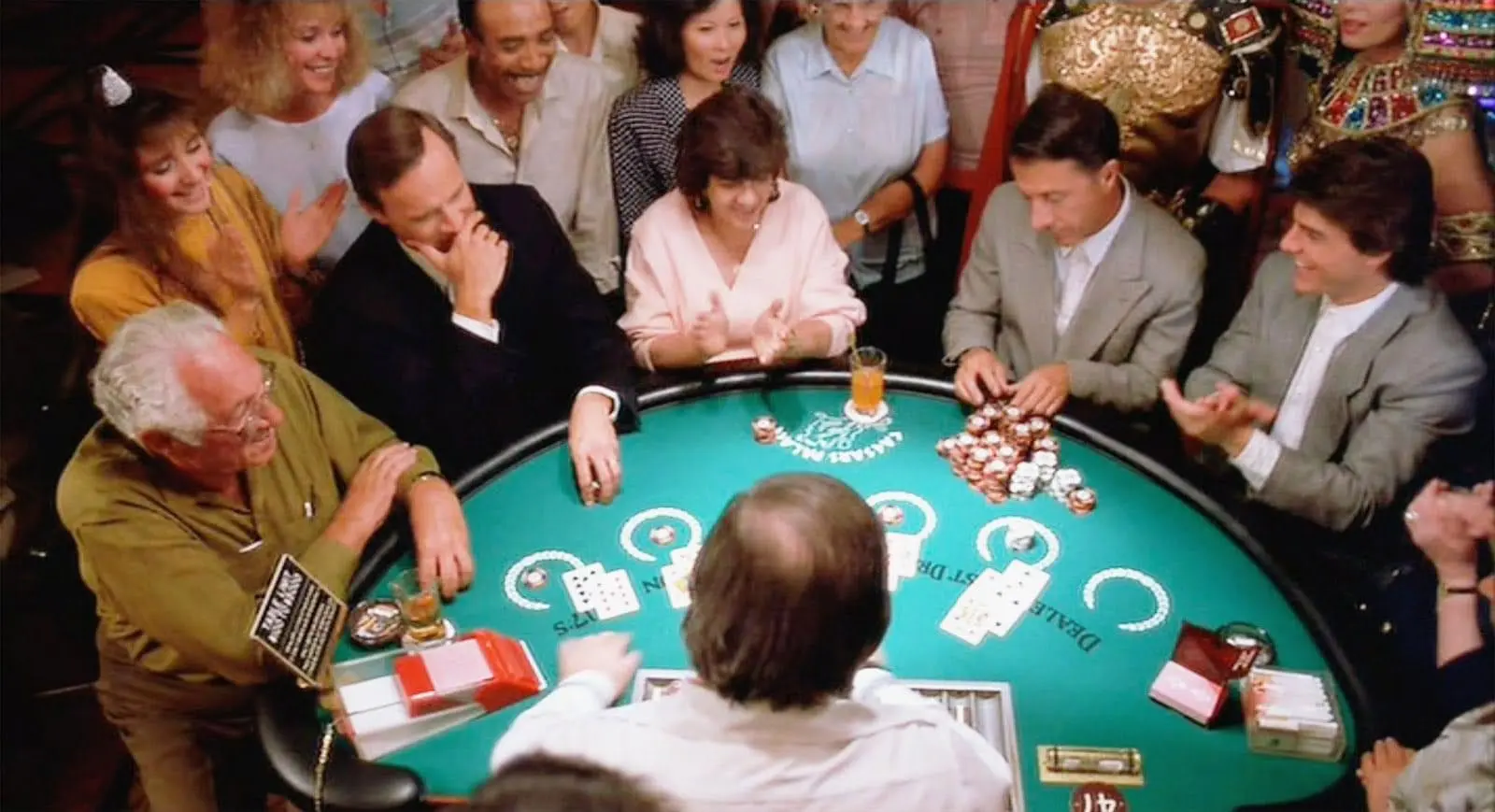
The Rain Man casino scenes are unforgettable because they are calm, procedural, and strangely intimate. There is no loud music. No flashing hero shots. Just cards, chips, and the steady rhythm of a man who never forgets a number.
When Raymond calmly says “Hit me” on an 18, it initially sounds wrong. Then it works. And again. And again. That is the moment Charlie realizes he isn’t guiding his brother anymore. He’s learning from him.
Is the Casino Scene in Rain Man Based on Real Gambling Strategies?
Not exactly. Raymond is not using traditional card-counting systems taught to advantage players. His mind functions as a flawless ledger. He remembers every card that has been played, calculates probability instantly, and never makes emotional errors.
That’s why the scene feels supernatural to casual viewers. It creates the impression that blackjack can be beaten simply by paying attention. In reality, card counting requires discipline, mental stamina, and bankroll control that few players can maintain long-term.
Still, Rain Man introduced card counting into mainstream conversation. For many viewers, it was their first exposure to the idea that blackjack is not purely luck-based. Casinos noticed. Surveillance policies tightened. Pit bosses became more alert. The film quietly changed the industry’s defensive posture.
Why Do Casinos Reference Rain Man When Discussing Blackjack Skills?
Because Rain Man created the archetype.
Whenever casinos train staff or warn players about advantage play, the name “Rain Man” surfaces as shorthand for anyone who might be counting. It became a cultural code for “this player is too accurate.”
Despite not ranking among the best gambling movies in terms of total screen time spent betting, Rain Man arguably influenced real casino behavior more than many full gambling films ever did.
The scene made blackjack feel beatable. That perception alone reshaped player curiosity, training guides, and even online betting education.
Rain Man True Story: The Real Inspiration Behind Raymond
Raymond Babbitt was inspired by Kim Peek, a real-life savant whose mind functioned at astonishing levels. Peek could read both pages of a book simultaneously, memorize thousands of volumes, and recall travel routes between any two cities.
Unlike Raymond, Kim Peek never gambled. He knew blackjack rules but never tested them at a table. The casino narrative is fictional, but the mental foundation was very real. That connection grounds the film in something deeper than fantasy. Raymond’s abilities were not invented. They were observed.
Dustin Hoffman’s Gambling Skills Off Screen
Hoffman himself is not known for gambling. However, his later role in HBO’s Luck shows his fascination with betting psychology, probability, and chance. He gravitates toward stories where systems, patterns, and unpredictability collide.
That curiosity is exactly what made his portrayal of Raymond feel authentic.
Rain Man didn’t just make people cry. It made blackjack players believe. And belief is far more powerful than luck.
Also Read-Big Win Slot: Understanding the Classic Slot Game Concept