
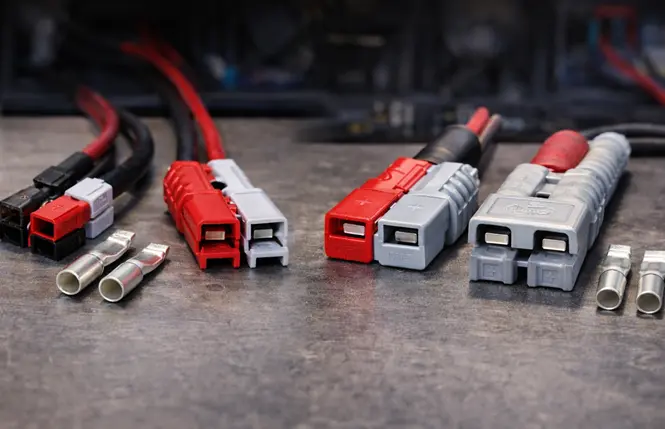
When designing a serious DC power system, the connection point matters just as much as the charger or battery.
High current demands clean contact surfaces, low resistance, durability under vibration, and long mating life cycles. That is why professionals consistently turn to solutions from Anderson power.
But one common question remains:
Should you choose Powerpole connectors or SB connectors?
The answer depends on amperage, application environment, modularity requirements, and system expansion plans.
Understanding Powerpole Connectors
Anderson powerpole connectors are modular, genderless DC connectors known for flexibility and compact design.
They are commonly used in:
- Amateur radio installations
- Overland builds
- Patrol vehicles
- Portable battery packs
- Marine electronics
- Robotics and industrial control
Key advantages of Powerpole connectors include:
- Modular housing configurations
- Flat-wiping contact system that self-cleans during mating
- Silver-plated contacts for low resistance
- Wire-to-wire and wire-to-board compatibility
- Compact footprint
Powerpole connectors typically support 15A, 30A, and 45A configurations, with higher-current variants like PP75 available for more demanding applications.
They are ideal when you need:
- Scalable multipole configurations
- Compact installations
- Frequent connect/disconnect cycles
- High mating cycle life
If your system requires modular flexibility and smaller gauge wiring, Powerpole is often the correct choice.
Understanding SB Connectors
Anderson power connectors are larger, heavy-duty, two-pole DC connectors designed for higher current loads.
They are commonly used in:
- Forklifts and material handling equipment
- Commercial charging stations
- Marine battery banks
- Emergency vehicles
- Industrial backup systems
- Electric vehicles
Key advantages of SB connectors include:
- One-piece rugged housing
- Genderless design
- High current capacity (50A–350A depending on model)
- Mechanically keyed color coding for voltage protection
- Stainless steel spring retention system
The SB50 and SB175 series, in particular, are widely recognized standards for high-amperage DC connectivity.
If your system involves:
- Large cable gauge (6 AWG and above)
- High continuous current
- Heavy vibration environments
- Commercial or industrial use
SB connectors are typically the stronger solution.
Current Capacity Comparison
Powerpole Series:
- 15A–45A common configurations
- Compact and modular
- Suitable for lighter high-current applications
SB Series:
- 50A–350A depending on housing
- Larger footprint
- Designed for sustained heavy loads
If your inverter or battery bank exceeds 50 amps continuously, SB connectors may provide better long-term durability.
Modularity vs Simplicity
Powerpole connectors allow you to stack housings into custom multi-pole blocks. This is extremely useful in:
- Communication systems
- Fleet wiring harnesses
- Modular power panels
- Portable equipment
SB connectors are simpler. Two poles, high amperage, rugged housing. They prioritize durability over modularity.
When flexibility is needed, Powerpole wins.
When brute strength is required, SB wins.
Contact Design and Performance
Both Powerpole and SB connectors feature Anderson’s flat-wiping contact system. This design:
- Cleans contact surfaces during mating
- Reduces arcing
- Maintains low resistance
- Increases connector lifespan
Silver-plated contacts improve conductivity and reduce heat under load.
This is why connectors from anderson power are widely used in mission-critical applications.
Environmental Considerations
Marine, fleet, and emergency vehicle environments introduce:
- Vibration
- Dust
- Moisture
- Temperature extremes
SB connectors tend to perform better in high-vibration industrial settings due to their larger housing and spring retention force.
Powerpole connectors perform exceptionally well in enclosed panels and controlled installations.
Choosing based on environment improves long-term reliability.
Wire Gauge and Installation
Powerpole connectors:
- Typically support 20–10 AWG (standard sizes)
- Ideal for panel wiring and moderate current
SB connectors:
- Support larger cable sizes (6 AWG and beyond)
- Designed for battery-to-battery or battery-to-inverter connections
Cable size often determines connector selection more than brand preference.
Fleet and Emergency Applications
In patrol vehicles and emergency fleets:
- Powerpole connectors are often used for modular communication equipment.
- SB connectors are used for battery connections and external charging interfaces.
Many professional builds use both — each serving a different purpose within the same system.
Marine Use Cases
In marine environments:
- Powerpole connectors are excellent for accessory circuits.
- SB connectors are ideal for high-current battery banks and shore charging systems.
Salt-air durability and vibration resistance make both suitable when installed properly.
Choosing the Right Connector
Choose Powerpole if you need:
- Modular configurations
- Compact form factor
- Frequent mating cycles
- Medium current applications
Choose SB if you need:
- High continuous current
- Larger cable gauge
- Heavy-duty industrial reliability
- Simple two-pole battery connections
Both platforms are engineered for low resistance, long lifespan, and safe high-current performance.
Final Thoughts
High-current DC systems demand more than just cable and hardware. The connector becomes the critical interface between power sources and loads.
Powerpole connectors offer modular flexibility and compact efficiency.
SB connectors deliver rugged, high-amperage durability.
Choosing the correct connector ensures safety, efficiency, and long-term system stability.
Build with Confidence at 12VoltPower
Explore professional-grade Anderson power products at 12VoltPower and select the right connector for your marine, fleet, or industrial power system.
Also Read