
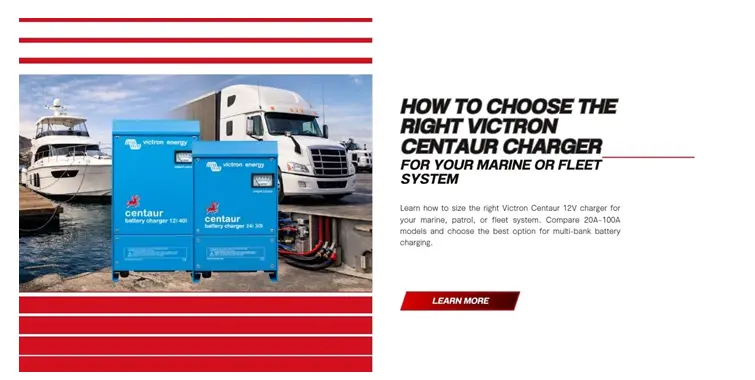
Meta Title: How to Choose the Right Victron Centaur Charger for Marine & Fleet Systems
When building or upgrading a 12V power system, choosing the correct charger is not just about amperage. It’s about battery bank size, duty cycle, environmental conditions, and how the system is actually used.
The Victron Energy Centaur series is designed for rugged, multi-bank charging in marine, fleet, patrol, emergency, and commercial applications. But with multiple amperage options available, selecting the right model requires a structured approach.
This guide breaks down how to properly size a Centaur charger for your system.
Step 1: Understand Your Battery Bank Size
The first and most important factor is total amp-hour capacity.
A common rule of thumb for lead-acid batteries is:
Charger output = 10–20% of total battery bank capacity
For example:
- 200Ah battery bank → 20A–40A charger
- 300Ah battery bank → 30A–60A charger
- 500Ah battery bank → 50A–100A charger
If your system regularly experiences deep discharge cycles, leaning toward the higher end of that range improves recovery time and battery health.
Step 2: Match the Charger to the Application
The Centaur ladder gives you structured sizing options:
12V / 20A
Ideal for:
- Small recreational vessels
- Auxiliary battery banks
- Light-duty fleet vehicles
12V / 30A
Best for:
- Balanced multi-bank setups
- Weekend cruisers
- Patrol boats with moderate electronics
12V / 40A
Great for:
- Growing marine systems
- Electronics-heavy builds
- Service vehicles with moderate loads
12V / 50A
Designed for:
- Larger house banks
- Multi-day usage
- Fleet builds with higher accessory draw
12V / 60A
Recommended for:
- Large cruising vessels
- Emergency marine units
- Heavy-duty mobile command systems
12V / 100A
Built for:
- Commercial vessels
- Large-capacity battery banks
- Industrial marine systems
Each unit functions as a rugged Victron energy battery charger with three isolated outputs capable of supplying full rated current.
Step 3: Consider Recovery Time
If your system is heavily discharged overnight, recovery speed matters.
For example:
- A 400Ah bank discharged to 50% requires approximately 200Ah to recharge.
- A 40A charger could take 5+ hours (not including absorption time).
- A 60A charger shortens that window significantly.
Fleet vehicles, patrol boats, and emergency platforms benefit from higher amperage to reduce downtime.
Step 4: Evaluate Environmental Conditions
The Centaur series is built for harsh environments:
- Aluminum epoxy powder-coated housing
- Drip shield design
- Stainless steel fixings
- Acrylic-coated circuit boards
- Internal temperature compensation
In engine rooms, high-humidity compartments, or salt-air exposure, this level of durability becomes essential.
Unlike smart Bluetooth chargers, the Centaur platform focuses on rugged reliability. For more integrated inverter systems, models like the Victron energy multiplus or Victron energy quattro may be considered in larger system designs.
Step 5: Battery Chemistry Compatibility
Centaur chargers support:
- Flooded Lead-Acid
- AGM
- GEL
Voltage selection is handled via DIP switch configuration.
If your system includes solar charging with a Victron energy mppt controller or advanced monitoring with a Victron energy monitor, pairing properly sized charging components ensures balanced system performance.
Step 6: Marine vs Fleet Considerations
Marine Systems
- Multi-bank configurations (house + start + auxiliary)
- Shore power variability
- Extended dockside storage
- Salt air exposure
Fleet & Emergency Vehicles
- Short engine-run cycles
- High accessory loads
- Fast recovery requirements
- Vibration and heat exposure
In marine systems, 30A–60A models are common for recreational builds.
In fleet and emergency applications, higher output options are often preferred to maintain readiness.
Step 7: Plan for Future Growth
Many systems expand over time.
Adding:
- Refrigeration
- Communications equipment
- Lighting
- Inverters
- Monitoring equipment
can increase load beyond original projections.
Choosing a slightly higher amperage Centaur provides headroom for future upgrades.
Why the Centaur Series Remains Popular
The Centaur platform is trusted because it focuses on:
- Stable three-stage charging
- Global 90–265V AC compatibility
- Temperature-compensated charging
- Three isolated outputs
- Rugged, corrosion-resistant construction
It is designed for reliability first — intelligence second.
That’s why it continues to serve:
- Commercial vessels
- Military craft
- Law enforcement marine units
- Fleet and utility vehicles
- Serious recreational builds
Final Thoughts: Sizing It Right the First Time
Choosing the correct Victron Centaur charger isn’t about buying the biggest model available. It’s about aligning charger output with:
- Battery bank size
- Recovery time needs
- Duty cycle
- Environmental exposure
- Future expansion plans
When properly sized, a Centaur charger protects battery lifespan, reduces downtime, and maintains system stability.
Build Your System with Confidence
At 12VoltPower, we carry the full range of Victron Energy charging solutions to support marine, fleet, and emergency power systems.
If you’re designing or upgrading a 12V multi-bank system, explore the Centaur lineup and choose the model that matches your operational demands.
Reliable charging starts with proper sizing.
Also Read